
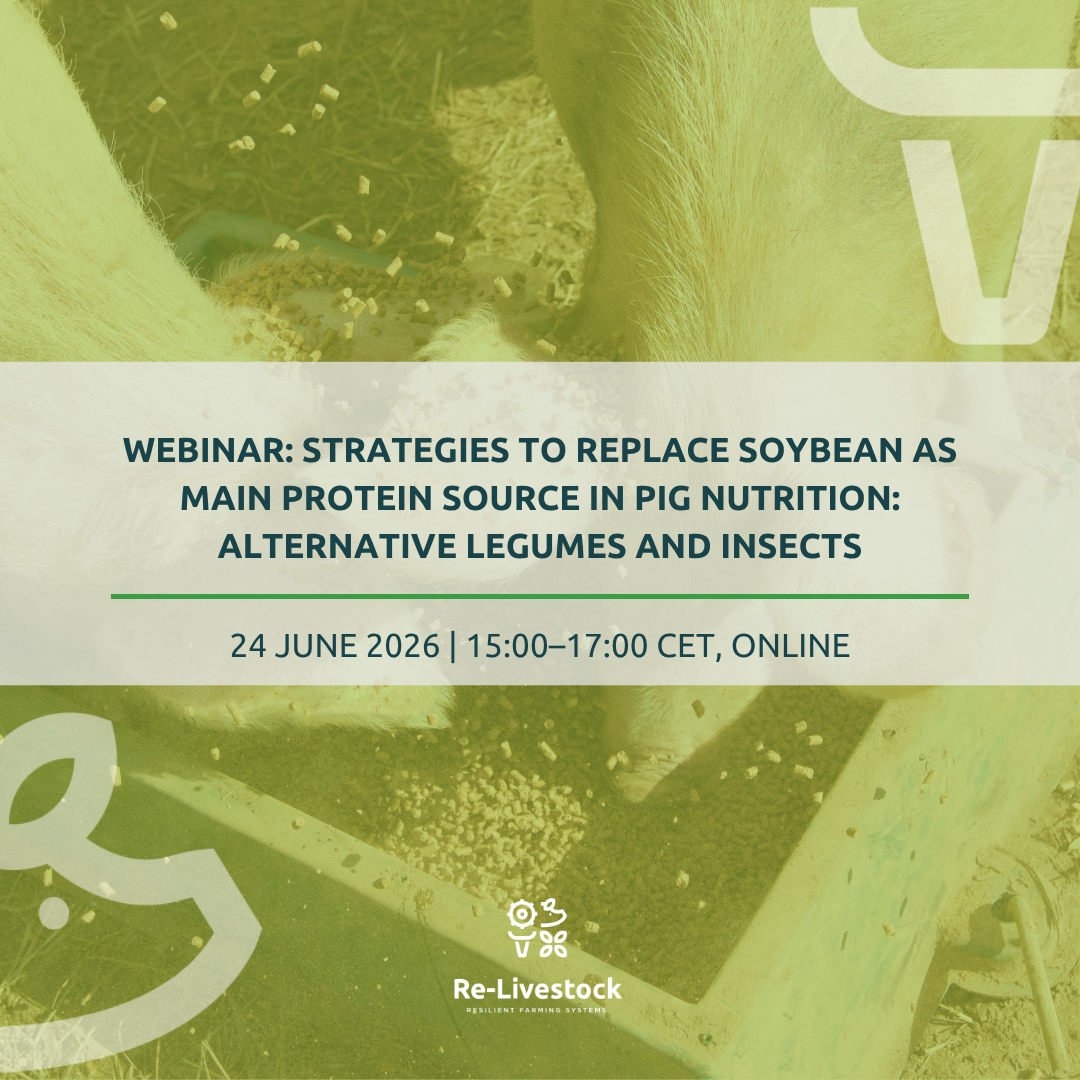
The European pig sector is facing challenges linked to sustainability, climate change, animal welfare, and market volatility. Building resilience in pig production systems is essential to ensure food security, reduce environmental impacts, and support farmers livelihoods.
📅24 June 2026 | 🕟 15:00–17:00 CET | 💻 Online webinar
OBJECTIVE
In this webinar, we will explore innovative approaches that contribute to lowering the carbon footprint of pig production while also supporting circular economy principles. The inclusion of alternative feed sources as some legume grains and insects in pig diets is a promising pathway to replace soya bean protein and accomplish the pig farming sustainability objectives.
The webinar will be structured around three lectures:
-
- The first lecture will explore to the development of legume grain crops to provide feed in quantity and quality to the European pig industry. There is a range of legume crops such with long history of use in animal feed, which were replaced by soybean in feed industry. Reverting this trend requires a constant of uniform supply. Perspectives and constraints will be presented and critically discussed.
-
- The second lecture will focus on advances on the use of insects as a protein source to feed pigs. The use of insects as an alternative protein source remains a major topic in the swine feed industry. However, their widespread adoption is still constrained by several limiting factors.
-
- The third lecture will present and discuss the results of the trials being done at CSIC in the framework of the Re-Livestock project. Field peas, lentils and chickpeas and yellow mealworm larvae and black soldier fly meals were used as a partial substitute for soybean meal to reduce carbon footprint of animal feeds.
AGENDA
15:00 – Welcome (CIHEAM Zaragoza and Re-Livestock Coordinator)
15:05 – Introduction to the webinar topic: replacement of soya in pig production – Rosa Nieto (CSIC-EEZ, Spain)
15.10 – Developing other grain legume crops as an alternative to soybeans in animal feed – Diego Rubiales (CSIC-IAS, Spain)
15.30 – Insects as an alternative to soybeans in pig feeding –Luciano Pinotti (Univ. of Milan, Italy)
15:50 – Local legumes and insects as sources of protein in pig feeding in Spain, in the context of the Re-livestock project – Ignacio Fernández Fígares (CSIC-EEZ, Spain)
16.10 – General discussion
16:45 – Wrap up and closure