From behavioural modelling to on-farm decision support in WP4
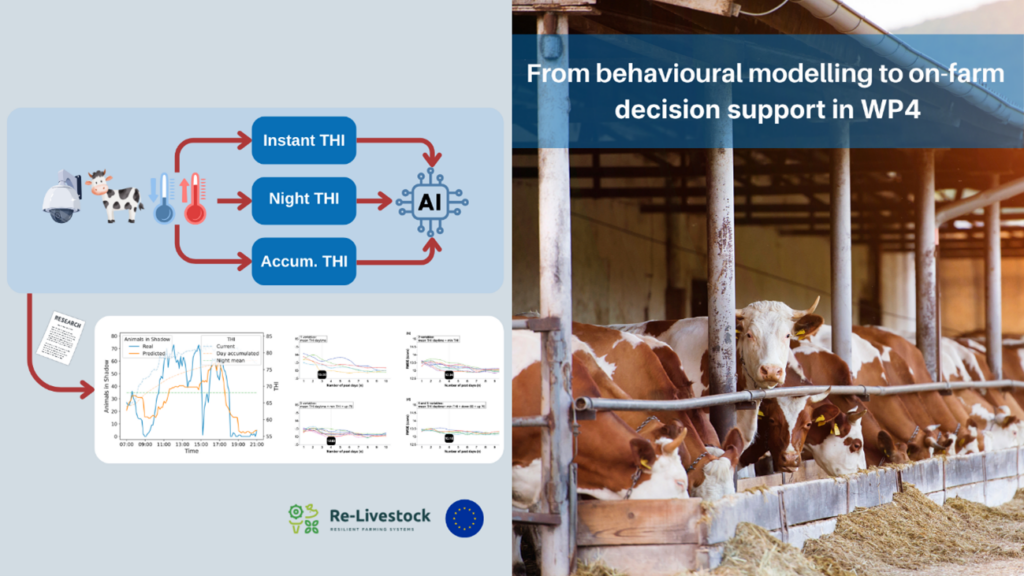
Within WP4 of the Re-Livestock project, partners are developing data-driven approaches to better understand and anticipate how dairy cattle respond to heat stress. By combining precision livestock farming technologies, environmental indicators (THI), and machine learning, recent work enables the prediction of shade-seeking behaviour under real farm conditions.
These advances support the development of early-warning indicators and practical decision-support tools, helping farmers improve animal welfare and adapt management strategies to increasing climate challenges.
Integrating behaviour, environment and AI to predict heat stress in dairy cattle
As part of WP4, recent research within the Re-Livestock project is contributing to the development of practical tools for heat stress management in dairy systems.
The work combines computer vision, environmental monitoring, and machine learning to model shade-seeking behaviour in dairy cattle as a proxy for heat stress. By integrating instantaneous and accumulated Temperature–Humidity Index (THI) indicators, the approach captures both immediate and cumulative thermal load, providing a more realistic representation of how animals respond to environmental conditions over time.
Results show that behavioural responses such as shade use are strongly influenced not only by current conditions but also by their temporal dynamics. This opens the door to predicting when animals are likely to experience thermal discomfort, enabling proactive management actions such as activating cooling systems or adjusting shade availability.
These developments directly contribute to WP4 objectives, particularly:
- Identification of behavioural indicators of heat stress
- Definition of thresholds and early-warning signals
- Support for farm-level decision-making under climate variability
The work is supported by recent scientific publications that explore the use of soft computing and machine learning techniques to predict shade-seeking behaviour in dairy cattle:
- Coupling PLF technologies and ML algorithms for predicting the use of shadow as a proxy for heat stress in young dairy cows (Biosystems Engineering, Accepted, in press)
- Soft Computing Approaches for Predicting Shade-Seeking Behavior in Dairy Cattle Under Heat Stress (Mathematics, 2025). https://www.mdpi.com/2227-7390/13/16/2662
Together, these advances represent a step towards scalable, low-cost, and non-invasive decision-support systems that enhance animal welfare and improve the resilience of livestock production systems across Europe.