
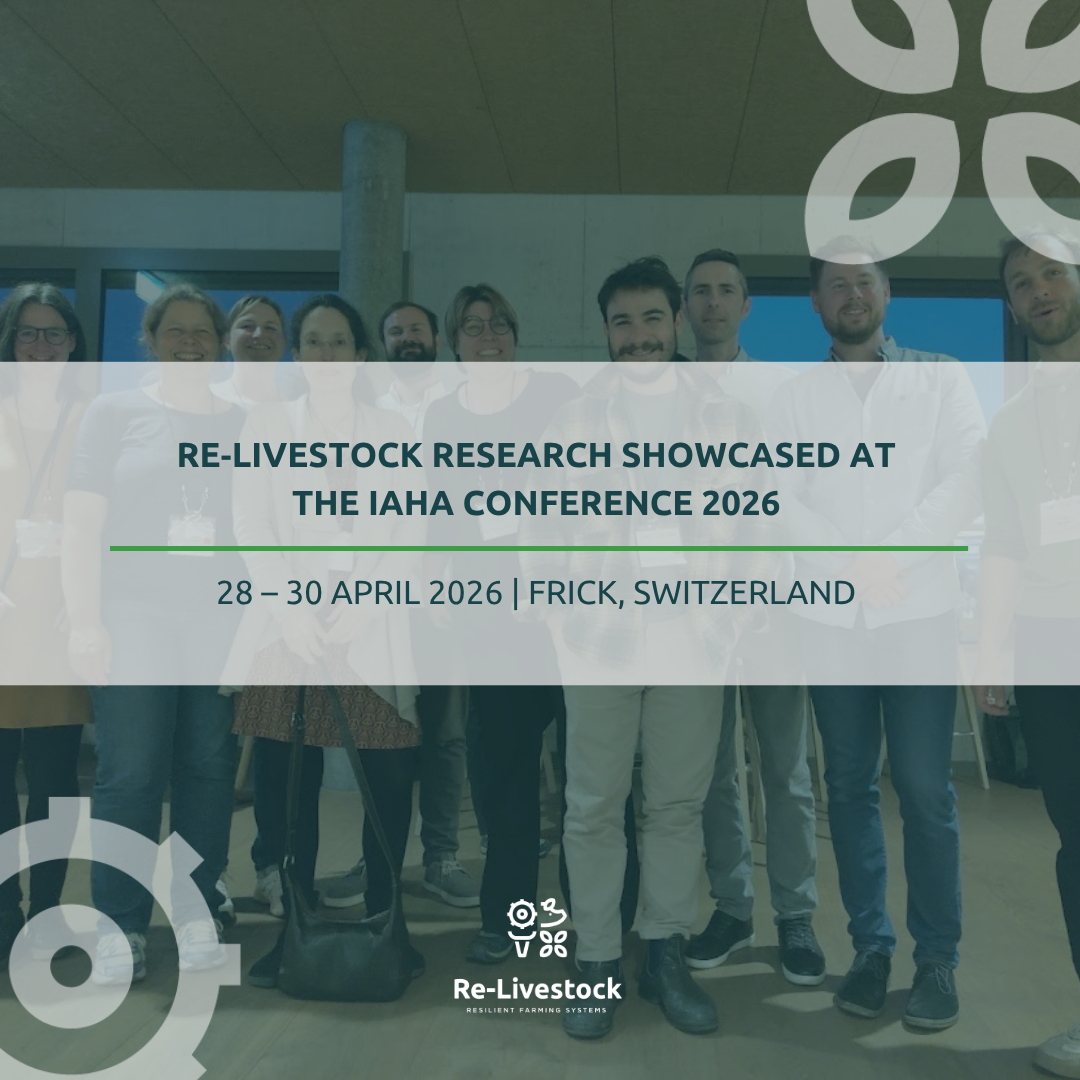
Re‑Livestock research was presented at the IFOAM Animal Husbandry Alliance (IAHA) Conference 2026, held from 28 to 30 April at the Research Institute of Organic Agriculture (FiBL) in Frick, Switzerland. The theme was “Organic animal husbandry: a role model for the future of livestock?”. The conference brought together researchers, farmers, advisers and other stakeholders to discuss how livestock farming can help build more sustainable and resilient food systems.
Three contributions presented research from different parts of the Re‑Livestock project. They covered farm resilience, agroforestry and the spatial assessment of future livestock systems.
Innovations for resilient livestock systems
Nicholas Davison and colleagues presented “Rooted in Resilience: How Organic Farming Innovations Could Shape the Future of Livestock Systems”, drawing on work from WP1 and WP5. The study used evidence gathered across the Re‑Livestock case studies. It explored how different farm‑level innovations can make livestock systems more resilient, and what can be learned from putting them into practice across different European farming contexts.
Organic pigs in agroforestry systems
Philipp Oggiano and colleagues presented “Environmental and Economic Performance of Organic Pig Fattening in Agroforestry Systems”. The study links farm‑level research in WP4 with environmental and economic assessment in WP5. It looked at an optimised Danish organic pig agroforestry system and asked whether changes in system design can reduce the environmental trade‑offs of outdoor pig production while keeping it economically viable.
Mapping livestock impacts across Europe
Giovanni Zucca and colleagues presented work from WP6, in particular Task 6.3, on the spatial assessment of livestock impacts on ecosystem processes. The spatial allocation model developed within Re‑Livestock maps livestock and food‑system scenarios across Europe. It links changes in production systems with livestock distribution, land use and environmental pressures. This makes it possible to assess how different ways of redesigning livestock systems affect soil carbon, nutrient balances and other environmental outcomes, at regional and European scales.
The three contributions are now published in the IAHA Conference proceedings, in Volume 17, Issue 1 of Animal – Science Proceedings: https://www.sciencedirect.com/journal/animal-science-proceedings/vol/17/issue/1
Taking part in events such as the IAHA Conference helps Re‑Livestock share its research with the organic livestock community and learn from it, supporting more resilient and sustainable livestock production systems in Europe.